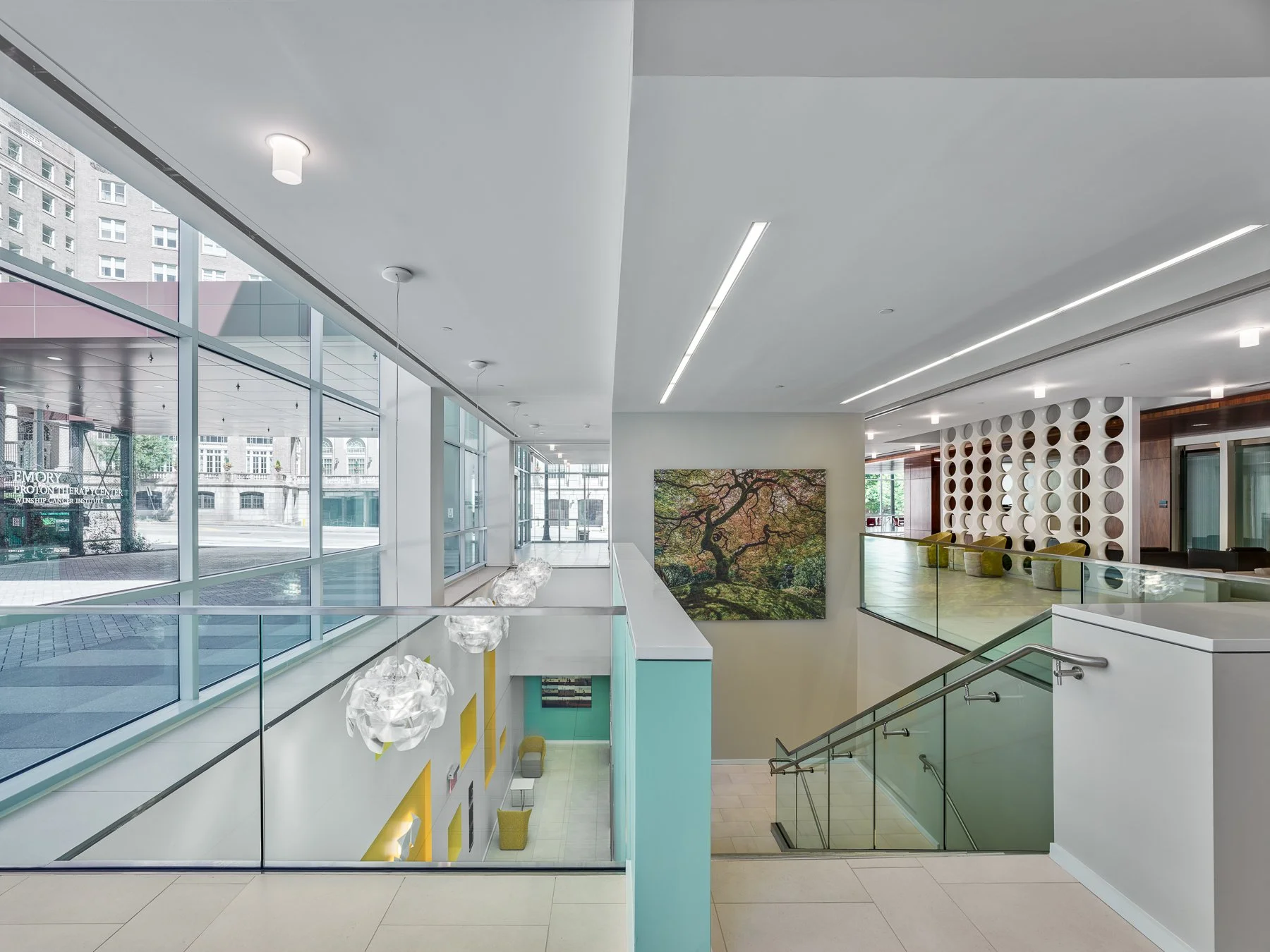
Healthcare environments are designed around clinical necessity — sightlines for staff, infection control, wayfinding for patients under stress. Art is easy to treat as decoration layered on afterward, if it's considered at all. But in a building where people spend some of the hardest hours of their lives, what's on the walls matters more than it does almost anywhere else.
We spent three years working with Emory Healthcare on exactly this question: how do you build a real art program — not just framed prints — across an active healthcare system, at scale, without disrupting clinical operations?
The scope of doing this properly
The Emory Healthcare program touched nine new specialty outpatient clinics, a 14-story, 358,000-square-foot medical superblock, a six-story diagnostic and treatment center, a 14-story medical office building, and a multi-story education and oncology center. That range is the point: a lobby, a waiting room, and a private patient room are three completely different environments with different needs, and a real art program treats them that way rather than applying one solution everywhere.
Lobbies can hold larger, more ambitious statement pieces — the first impression of the building. Waiting areas benefit from work that's calming without being sterile; people spend anxious, unhurried time there and notice more than they would passing through a hallway. Private patient rooms are the most intimate and the most constrained: the art has to hold up to being seen at close range, day after day, by someone who didn't choose to be there.
Local artists, real placement
Throughout the program, we placed original and limited-edition fine artwork from local artists, including Krista Clark, Rocio Rodriguez, Joe Camoosa, Kirstin Mitchell, Namwon Choi, Don Cooper, Donna Mintz, and others. Sourcing locally wasn't incidental — it meant the art reflected the community the hospital actually serves, and it made a program of this size logistically realistic to execute and maintain.
What this means if you're planning a healthcare space
A few things consistently matter in clinical art programs: durability and ease of cleaning have to factor into material choices, not just aesthetics; placement should be planned by room type, not applied uniformly; and the program should align with the facility's brand identity — ours was developed alongside a refreshed brand for Emory's creative direction, so the art reinforced the same message as everything else in the building, rather than existing separately from it.
Art in a healthcare setting isn't a finishing touch. It's part of the experience of the building itself, for patients, families, and staff who are there far longer than they'd choose to be. If you're planning new construction, a renovation, or a system-wide refresh and want to talk through what an art program could look like, book a consultation.